
Defending the abrogation of Article 370 of the Constitution, the Centre on Monday told the Supreme Court that the entire region of Jammu and Kashmir has witnessed an "unprecedented" era of peace, progress and prosperity, with street violence, orchestrated by terrorists and secessionist networks, becoming "a thing of the past."
'The BJP think they are running an ideology machine in this country, and they have to convert everyone, from people to parties to party leaders.'
'The stimulus message was tagged on to what was meant to be an exhortation to self-reliance, glossing over the near impossibility of merging the immediate requirement of relief for a huge population and a questionable strategy for the future trajectory of a large economy aspiring to superstardom,' points out Shreekant Sambrani.

Overall, the Survey warned that unless shifts in the vision of development were articulated and embraced, the Indian economy would lose the chance to move to a high-growth trajectory.
Subbarao said, short-term as well as medium-term prospects or Indian economy continue to be grim. Fiscal deficit is going to be much higher, the debt burden much larger and the financial sector will be in a worse shape.

Experts say the party is undoing what it achieved through MNREGA by targeting beneficiaries

'What will this supposedly more business-friendly government do if it gets a second term?' 'Important labour law and land reforms remain off the table.' 'Witness the arm-twisting of foreign players in e-commerce and all but one player in telecom -- and it is very hard to justify this perception that the BJP is business friendly.' 'There will also remain the real risk of ideas seemingly gleaned from the pages of Amar Chitra Katha, overlaid with PowerPoint presentations,' predicts Rahul Jacob.

'There are many things we need to work on.' 'At the heart of it is, one, the extent of inequality, which is not good for democracy and nation; two, a structural decline on how a country ought to function, how people should be held accountable, whose role is what.'

'Nobody is talking about the inequality that is going to come.'

In a Q&A with Doordarshan, Jaitley discusses how he chose the areas on which he would spend more.

Stepping up his attack on the Bharatiya Janata Party government, Congress leader Rahul Gandhi has alleged that the structures of Indian democracy are under 'brutal attack' and there is a full-scale assault on the institutions of the country.

'When I was toying with 10 different ideas, my father was diagnosed with lung fibrosis and his condition deteriorated so badly that we lost him in six months. He was very unsatisfied with the lack of proper diagnosis.' 'It made me think will anyone do a biopsy if there is no symptom? Why is it that we do not have any non-invasive diagnostic method?' 'This idea was the strongest out of the ten, and with Snahlata Singh with her cancer biology background joining me, the idea got a real boost.'
Chief Economic Advisor Arvind Subramanian says that he hopes GDP growth will be at the upper end of the 7-7.5 per cent range.

There will be pressure on the fiscal situation, especially at a time when the monsoon can also disappoint. More populist expenditure is on cards if the mandate is a hung Parliament or a coalition government.

Anil Rego, CEO, Right Horizons, answers your personal income tax queries.
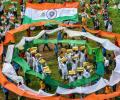
How should one billion Indians, for whom deprivation has become an inescapable way of life, join us in celebrating 75 years of Independence? And where do we go from here? asks Kalyan Singhal.

The country must get its act on global alliances right in order to feed its fuel-hungry economy, points out Subhomoy Bhattacharjee.

'There will be positive growth, but if you ask me whether we are going to have the original growth rate of 8%, the answer will be, no.'

Does Abhijit Banerjee's Nobel Prize help India reduce extreme poverty, asks Rajeev Srinivasan.

Naturally, the West Bengal chief minister is not leaving anything to chance, reports Ishita Ayan Dutt.

The negative aspect about the Budget is that the capital expenditure has been marginally cut to achieve the fiscal deficit target assumptions, and the onus of sustaining investment demand till private capex revives continues to vest with the public sector enterprises, notes Jyotivardhan Jaipuria.

'For someone who wants to invest for the future or his family, diversification is necessary.' 'Diversify across asset classes -- equities, gold, real estate, fixed income, commodities, and even cryptocurrency.'

Of the seven surveys presented under Modi govt, predictions of three were quite close to the actual GDP growth rate, one saw the base year change in between, but the last three were way off the mark.

'India has formed tremendous resilience and still a strong growth.'

'In investing, you have to first make sure you don't make big mistakes.' 'I would advise small investors to be systematic, don't be arbitrary; don't be on either end of the risk spectrum.' 'Don't go from fixed deposit to option trading or crypto trading.'

The richest one per cent in India now own more than 40 per cent of the country's total wealth, while the bottom half of the population together share just 3 per cent of wealth, a new study showed on Monday.

The right investment at the right age will help you enjoy a secured post retirement life.
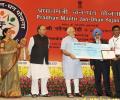
As per the latest finance ministry data, the total balance in over 36.06 crore Pradhan Mantri Jan Dhan Yojana (PMJDY) accounts was at Rs 1,00,495.94 crore as on July 3.

When turbans are allowed on school and college campuses, or sacred ash on the forehead, can one ban the hijab? asks T N Ninan.

The richest one per cent in India now own more than 40 per cent of the country's total wealth, while the bottom half of the population together share just 3 per cent of wealth, a new study showed on Monday. Releasing the India supplement of its annual inequality report on the first day of the World Economic Forum Annual Meeting in Davos, rights group Oxfam International said that taxing India's ten-richest at 5 per cent can fetch entire money to bring children back to school. "A one-off tax on unrealized gains from 2017-2021 on just one billionaire, Gautam Adani, could have raised Rs 1.79 lakh crore, enough to employ more than five million Indian primary school teachers for a year," it added.

No longer Bengal's finance minister, Amit Mitra, Mamata's principal chief advisor, will still advise and aid the 'chief minister and finance department on all matters relating to management of state finance', represent the 'state government in national and international events/meetings/committees' and examine 'important proposals/files and policy issues relating to financial matters referred to him for advice/views'.
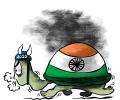
'Slowing down of the economy was mainly due to the demonetisation shock...' 'If you cut off the oxygen supply to a patient in the ICU and the patient dies, the patient does not come alive again when you restore the oxygen supply.'

'Healthcare workers treating coronavirus have been among the hardest hit.' 'It is scary, but this is what we signed up for and became doctors.'
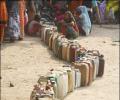
The research found that 50% of the people were receiving either nothing or less cash than they were entitled in lieu of the subsidised grains that were stopped under the pilots starting from September 2015 till May 2016.
'We're going to campaign across the country to convince more candidates to endorse some/all of these issues -- and hold them to their promises if and when they are elected.'

This doctor couple put their faith in India. And in return India has put faith in them.
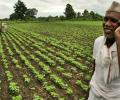
The scheme, which would give Rs 6,000 to small farmers in a year or Rs 500 a month, will add more money to the account of these cultivators than the money he/she saves every month on an average.

It will be interesting to see whether India-China border tensions figure during the deliberations of PLA deputies to the NPC and CPPCC, notes Jayadeva Ranade, the distinguished China expert and retired RA&W officer.

The substantially increased economic dualism may exert lasting negative influences which could include a reduced potential for economic growth; the persistence of a very weak employment and poverty situation; rising social and political discord; and heightened vulnerability to geopolitical challenges, cautions Shankar Acharya, former chief economic adviser to the Government of India.

'Rather than cutting and pasting from advanced economies, we should use basic economic principles to think about what is right for India at the stage of development at which we are,' says Chief Economic Advisor Krishnamurthy Subramanian.
